

Hey, Real Quick
Early language and literacy

Nothing fancy this week, it was my birthday on Thursday (THIRTY GREAT) but I do want to pop in and bring some focus to the literacy end of It's Elementary.
On February 4th, Timothy Shanahan released additional commentary on the Emily Hanford podcast Sold A Story.
Some key takeaways from Shanahan:
“the most popular reading programs [are] out of alignment with the best knowledge that we have about teaching and learning reading.”
The most popular reading programs he is referring to Fountas & Pinnell and Lucy Caulkins that approximate to somewhere in the ballpark of 40-50% of US schools.
He goes on, however, to quantify the amount of gains that have been seen historically when the U.S has emphasized decoding and phonics:
“If each year’s phonics instruction managed to accomplish the amount of benefit suggested by those effect sizes (about 20% of a standard deviation or about 2 months added gain over a school year), our kids would be doing about 1 semester better in reading by 4th grade.”
In education, we have the *bon mot*: before 4th you are learning to read. Starting in 4th, you read to learn. This brings us to:
“Even during those eras when phonics instruction and 4th grade reading performance rose together, they have not managed to have a big influence on NAEP 8th grade or 11th grade scores.”
Yikes! To clarify, I will draw our attention to Scarborough’s Reading Rope:
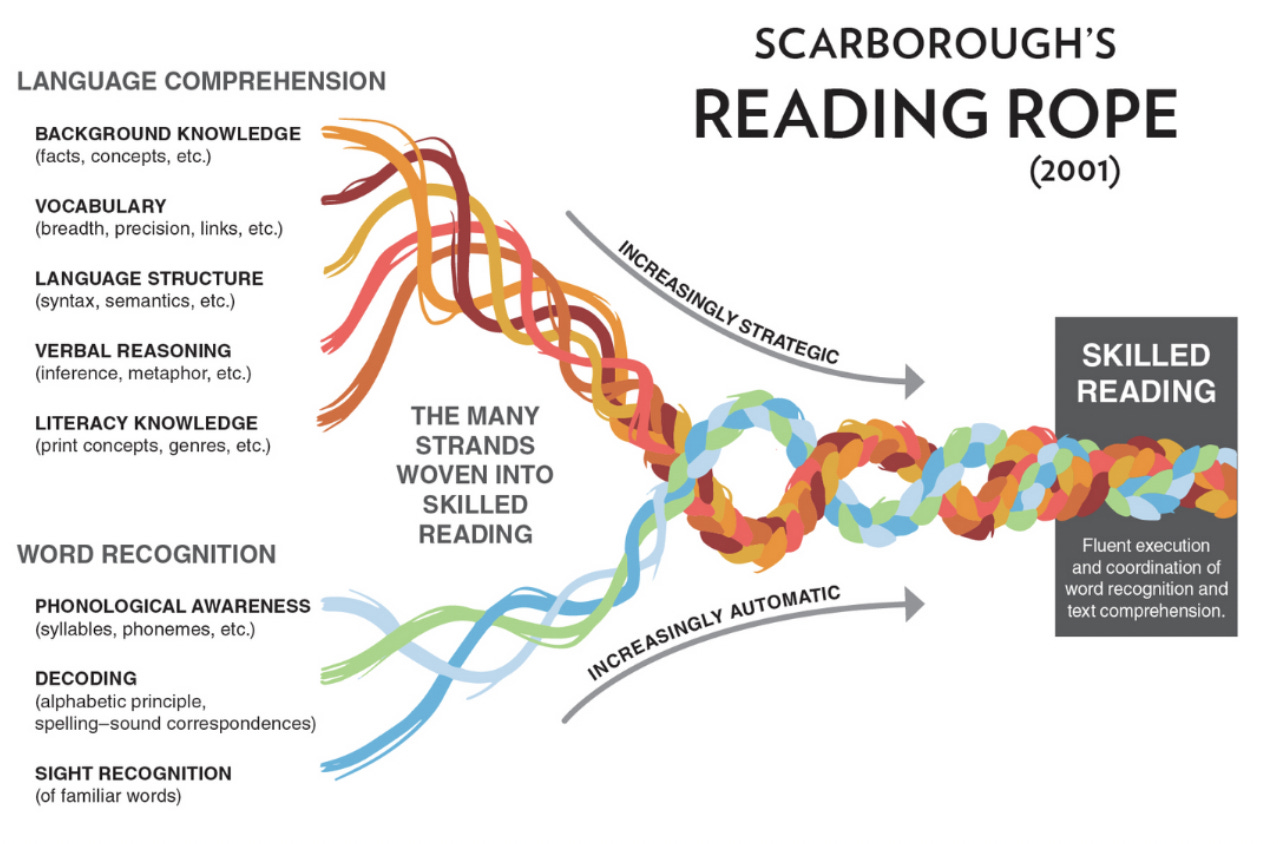
Decoding and phonics (the aspects of literacy instruction woefully absent in many current elementary schools) are just 3 of the 8 elements that are ‘woven into’ skilled reading.
Notice the first two elements of language comprehension: background knowledge and vocabulary. In 4th grade, when students switch into the ‘reading to learn’ phase of their education, the majority of their understanding hinges on these elements.
Natalie Wexler, wrote a book, and has a Substack, addressing what she titles “The Knowledge Gap.” In fairness, I have not read, but can give a hearty “yup!” having been asked things by middle schoolers like “What is New Hampshire?” Knowledge is a big deal. You could even say that it is so important as to be…elementary!
There is another education *bon mot* for students with poor comprehension: a word caller. This student decodes fluently but is unable to answer basic comprehension questions. In some ways, these students are even more challenging to remediate because there is no way to adequately backfill a childhood of lived experience and exposure to language.
After a certain point, trying to analyze and decide who is responsible for teaching children to read just becomes a rabbit hole of confounding variables. And the uncomfortable truth is that we can’t put it all on schools.
What if more parents, physicians, and community stakeholders understood that by the time many of our kindergartners got into a classroom, they were potentially 3 years behind some of their peers?
The American Association of Pediatrics understands the importance of early language and literacy. Programs like Zero to Three, and The Basics take a public health outreach approach to increasing parent awareness of language and literacy, as part of a broader framework for early child wellness.
Why are these programs not more widespread?
I’ve thought about a lot of things this week- the birds in my side yard, other terra cotta pots, but most importantly, I’m pretty sure, as long as we keep a myopic focus on school age children, we are ignoring the most important demographic to improve literacy in the United States.
Really excellent points here, Laura. I only discovered your newsletter recently -- this was the first post that arrived in my inbox -- but I'm glad I did! Looking forward to more.
Thank you so much!